Describe it once.
Watch it become software.
Tell the Engineering Pipeline what your business needs, in plain words. It understands you, designs the software, builds it, and proves its own work — then hands you something ready to run, and a record of exactly how it was built.
It's 11pm. You've finally written down exactly what your business needs. Now comes the part you dread.
Getting someone to build it. You'll explain it in a kickoff call. You'll explain it again in week three, when the first version isn't quite right. You'll explain it a third time after the demo, pointing at the one screen that matters and saying "no — like this." Months pass. Invoices arrive. And what comes back is close enough to feel like progress and wrong enough to keep you awake.
You already did the hard part. You know what you need. The Engineering Pipeline exists so that knowing is enough — so the distance between the sentence in your head and the software on your screen stops being measured in months and misunderstandings.
The bottleneck was never one step. It was the seams between them.
Speeding up a single step just moves the pile-up somewhere else.
A faster coder
Writes the wrong thing sooner, because the misunderstanding upstream was never caught.
A code generator
Hands you a thousand files and a new job: making them a coherent, tested, trustworthy whole.
A project manager
Coordinates the handoffs — but every handoff is exactly where meaning leaks out.
The Pipeline owns the whole journey — so nothing is lost between the steps.
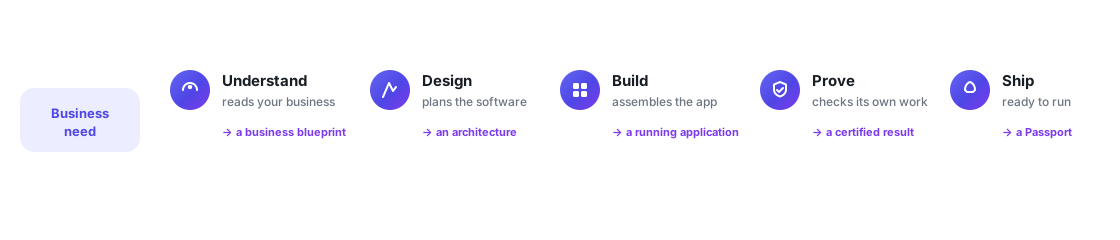
Fifteen stages. Five moves. One continuous line.
Each stage hands the next something real — never a vague summary.
Understand
Business Requirement → Business Understanding → Clarification → Business Reality Model. BELA reads your need, models your business, and asks about the parts that are ambiguous — before anything is built.
Design
Architecture → Engineering Reality → Technology Selection. It decides how the pieces fit and chooses the right technology — provider-neutral, with a reason for every choice.
Build
Project Assembly. The whole application is assembled into one working piece of software — not a scattering of snippets.
Prove
Testing → Self Review → Self Repair → Qualification → Certification. It tests, reviews, and repairs its own work, then certifies the result — before you ever look.
Ship
Deployment → Production-Ready Software. It prepares the finished software to run, and hands it over with an Engineering Passport.
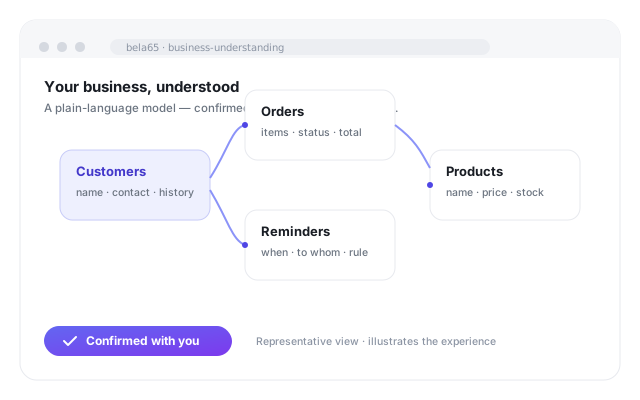
Before a line of code, it draws your business.
This is what "Understand" produces — a plain-language model you can actually read and confirm.
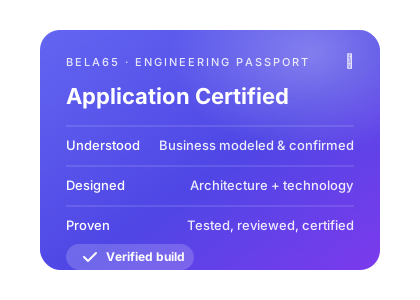
A running application — and a passport that proves how it was built.
Most delivery ends with a handoff and a hope. The Pipeline ends with two things you can hold: software that's genuinely ready to run, and an Engineering Passport — a plain record of what was understood, designed, and proven. Not a promise. A receipt.
You stop paying the misunderstanding tax.
Assistants make a person faster. The Pipeline makes the outcome yours.
A difference of philosophy, not a swipe at any tool.
| Hire & manage a build | AI coding assistant | Engineering Pipeline | |
|---|---|---|---|
| Who owns the whole journey | You (and a project plan) | Still you | The Pipeline |
| Where meaning gets lost | Every handoff | Between prompt and product | Nowhere — one continuous line |
| Who checks the work | Someone, eventually | No one | It checks itself, before you |
| What you can show afterwards | Invoices | A commit history | An Engineering Passport |
The things founders actually ask
You already know what you need. Let's make knowing enough.
Bring one real business need. We'll take it through the whole journey and hand you software — and its Passport.